|
Angkor Wat at sunrise. Taken by yours truly in December
2009 (as are all of the photos in this post) |
Angkor Wat is arguably the most recognized archeological
site in Southeast Asia—perhaps in Asia at large save the Great Wall of China
and Taj Mahal. Angkor Wat is the central iconic temple, although the entire
complex is often referred to as “Angkor Wat” and used interchangeably with
names such as “The Temples of Angkor” or “The Angkor Wat Complex.” Angkor Thom
city complex was built during the thirteenth century, during which King Jayavarman
VII ruled. In 1992, Angkor Wat Complex became a UNESCO World Heritage site,
with today two million and counting tourists visiting each year.
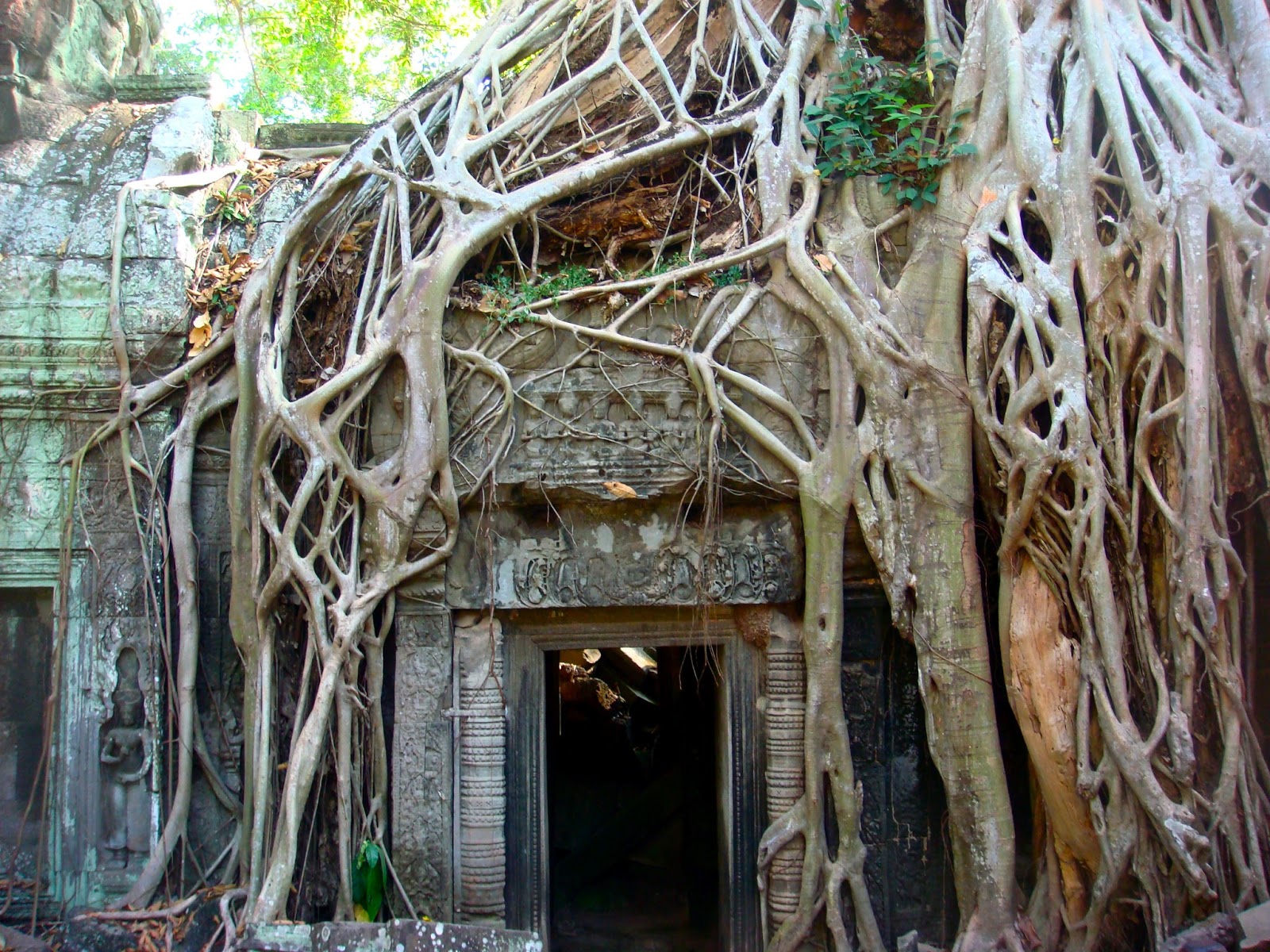
 |
Ta Prohm Temple at Angkor, made partially famous by
Angelina Jolie. |
In 1861, the French colonists discovered and began
excavating the archeological site. This included taking artifacts for French and European museums—instigating a looting trend that continues today. Although
when the French first “discovered” Angkor, “a labyrinth of monumental
structures entangled with tree roots and lichen,” they claimed it was “‘lost,’
even dead,” this is fundamentally not true (Winter 53). There were actually
multiple local villages peppered throughout what is today the archeological
park. The French used the aesthetics of Angkor as abandoned and wild to promote
the romantic mythology of loss and rediscovery (Winter 53). This mythology
perpetuates today, in tourism and in Cambodia’s political rhetoric (Winter 53).
Even after Cambodian independence from France, France still took an active role
in Angkor Wat’s and its surrounding temples' maintenance until approximately 1972,
when the political situation was too unsafe to continue.
 |
| Cliché Angkor Wat pond reflection at sunrise |
This coincided with the inauguration of the first United
Nations Educational, Scientific, and Cultural Organization (UNESCO) World
Heritage Convention, also in 1972. The umbrella organization UNESCO was created
in 1945 after World War II along with the United Nations. UNESCO’s goal at its conception was to
promote “solidarity, peace, and equality” through “the free exchange of ideas
and knowledge,” because the lack of these qualities was the root of war
(Nielson 274). The initial 1946 document of UNESCO “UNESCO Its Purpose and its Philosophy”
states a need for diversity and global appreciation of the arts, all while
stitching nations together in unity—politically and scientifically—to prevent
another war and bombing. UNESCO good-willingly promoted a global culture and
knowledge sharing to perpetuate peace (Huxley 14). “UNESCO Its Purpose and its
Philosophy” does mention that all cultures should receive equal attention, yet
are not worth the same; however, who is determining this “worth” (Huxley 42)?
The rhetoric echoed throughout the paper centers on preventing war, although
today, extreme unity among nations can be considered homogenizing or hegemonic.
The video
UNESCO – Its Evil Purpose and Philosophy mostly discusses how
UNESCO stifles independence, rocks national sovereignty, and also has an
“indoctrination” view of education. Although one can perceive “UNESCO Its
Purpose and its Philosophy” today as stating this, it is important to remember
that it was written after World War II and with good intentions to build global
harmony and prevent war. That being said, much of UNESCO’s rhetoric is simple
and idealistic and fails to fully grasp complex concepts (Nielson 284).

The 1972 convention set the groundwork for creating a list
of UNESCO World Heritage sites, made official in 1978. Today,
there is a broad range of 962 cultural, natural, and “mixed” UNESCO World
Heritage sites, as well as multiple sites in the midst of being evaluated or on
the “List of World Heritage in Danger." In general, the
overwhelming majority of the sites are over two hundred years old and are not
part of “industry,” “technology,” or “modernity.” Although sprinkled with good
intentions, World Heritage sites emerge as more problematic, notably in
developing countries, than positive due to their museumification and faulty
temporal designation. UNESCO creates standards, often derived from Western
forms of thought, for designating cultural objects and sites around the world. Oftentimes, a cultural site is not given UNESCO
status if it is not deemed aesthetically pleasing or conflicts with western
visions of heritage. Within UNESCO, according to archeologist Henry Cleere:
Culture manifests
itself principally in the form of archeological sites and monuments from
classical Greece and Rome, European architecture from the later Middle Ages to neo-classicism,
and the art and architecture of the Indian subcontinent and imperial China
(32-33).
World Heritage sites are preserved in the past as
“untouched” or “ancient sites” as a means of asserting their discontinuity with
the present—creating separated gems of culture. Indeed, UNESCO often constructs
World Heritage sites as intrinsically antique, aesthetically pleasing, and
societally detached without contemporary implications or interactions with
surrounding communities. This is certainly true of Angkor, especially with
reference to French perception of the site.
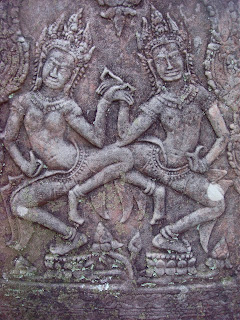 |
| Intricate Angkor sandstone carvings |

In 1993, the year of the United Nation’s sponsored first
free elections in Cambodia, the government started being more active in
preserving Angkor Wat, but was still at the mercy of international bodies. Attention to the archeological site was extremely needed given the mass amount of looting occurring since the
Khmer Rouge era, and before with the institutionalized looting of the French. In 1992, Angkor Wat was named a UNESCO World Heritage site,
but not without the help of multiple other governments, naming Japan and France. The Declaration of Tokyo, written in
1993, expressed “the urgent need for international assistance to prevent the
Angkor monuments from further decay and destruction” (Di Giovane 335). Cambodia
was not heavily involved in formulating the Angkor development project that
would later be imposed. Because of this un-involvement, “understanding Angkor
as a form of ‘living heritage’ remains neglected” within the current management
framework: crafting Angkor as an ancient site belonging to the past, similar to
how the French framed it (Winter 50).
Attempting to return to this past time of Khmer glory became
the basis of Pol Pot’s Khmer Rouge reign—even though the Khmer Kingdom was
during the thirteenth century and Pol Pot used the term “year zero.” He admired
the intricate irrigation system that the Angkor kings had built, allowing for 3-4
crops a year, and tried and failed at replicating these in a quest for Cambodian self-sufficiency
(Brinkley 20; Stark & Griffin 121-122). Pol Pot wanted to defy seasonality
and plant rubber, coconut, rice, and cotton all year long (Winter 58). In reality, the “hydraulic theories of
early 20th-century French scholars” that Pol Pot copied was in
“part historical fantasy” (Winter 58). Regardless of using Angkor Wat as a
symbol during an awful period of turmoil, genocide, and civil war, the Angkor temples still hold great national importance in Cambodia.
According to Miriam P. Stark and P. Bion Griffin, “Nowhere
is this linkage between nationalism and heritage management more evident than
in Cambodia.” Angkor Wat is “a vehicle of agency” to help Cambodians understand
their identity (Winter, 50). Nonetheless, Angkor tourism is centered on
“high price tourism,” as well as the overall high “quality of the [tourist] experience”
(UNESCO in Winter 55). This bars local, and often poor, tourists from going to the site to visit
(picnicking in the temple's fields was once a popular pastime) or for prayer at one of the many
Buddhist pagodas in the temples. Pol Pot once denied Cambodians “a celebration of
their own cultural heritage…[and]…traditional Cambodian holidays were not
observed” as travel was not allowed (Winter 58). Not only was it recently opened up to the international tourist market, but also to Cambodians themselves. Angkor Wat, therefore, holds
lots of meaning for the Cambodian people. As Cambodia continues to reconstruct its
society, living heritage can be used as a vital contributor “to the ongoing constitution
of national, cultural, and ethnic identities,” but not when international bodies promote otherwise (Winter 64).

Although the government (international and Cambodian) and even some Cambodians wish to see
Angkor as a modern tourist site, Cambodians generally agree that the complex
must keep some of its traditional structures and management should allow
the Khmer people to see their heritage and enjoy the temples (Winter). This cannot be
done, however, if Cambodians cannot have their voice be heard in the mainly international bureaucracy governing the site. Their heritage has been marketed
to be something beyond the Cambodians themselves and for other peoples’ consumption.
Nonetheless, according to UNESCO, all of the cultures and sites in the world
are for an international body to appreciate. Whose “heritage” is it? If “all
the world’s a stage,” as sixteenth century English poet William Shakespeare
once said, then UNESCO World Heritage sites emerge as “playhouses of
diversity,” and platforms for re-presenting “imagined dramas” and settings for
a global audience (Di Giovine 275). UNESCO removes agency from the people
and spreads it globally—the consequences being positive or negative, depending
on the point of view.
Works Cited:
Brinkley, Joel. Cambodia's Curse:
The Modern History of a Troubled Land. New York, New York:
PublicAffairs, 2011. Print.
Cleere,
Henry. “The World Heritage Convention as a Medium for Promoting the Industrial
Heritage.” The Journal of the Society for
Industrial Archeology 26.2 (2000): 31-42. Print.
Di Giovine, Michel A.
The Heritage-scape: UNESCO, World
Heritage, and Tourism. New York, New York: Lexington Books, 2009. Print.
Nielson, Bjarke. “UNESCO
and the ‘right’ kind of culture: Bureaucratic production and articulation.” Critique of Anthropology 31.4. (2011):
273-292. Print.
Stark, Miriam T. and P. Bion Griffin. “Archeological Research
and Cultural Heritage Management in Cambodia’s Mekong Delta: The Search for the
‘Cradle of Khmer Civilization.’” in Baram, Uzi and Yorke Rowan, eds. Marketing Heritage: Archaeology and the
Consumption of the Past. New York, New York: Altamira Press, 2004. Print.
Winter, Tim. “Landscape, Memory, and Heritage: New Year
Celebrations at Angkor, Cambodia.” in Harrison, David and Michael Hitchcock,
eds. The Politics of World Heritage.
Tanawanda, New York: Channel View Publications, 2005. Print.
.JPG)
.JPG)
.JPG)